(970) 927-9668
For nearly six decades, Michael Kessler has drawn from his lifelong relationship with trees and the forest. Time spent camping, fishing and observing the woods has continually shaped his abstract practice, from the vertical rhythm of tree trunks to the movement of branches in the wind and the histories recorded in a forest’s layers.
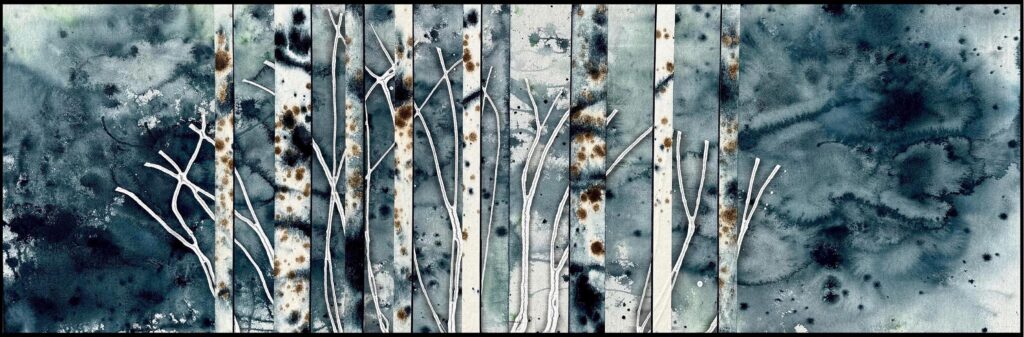
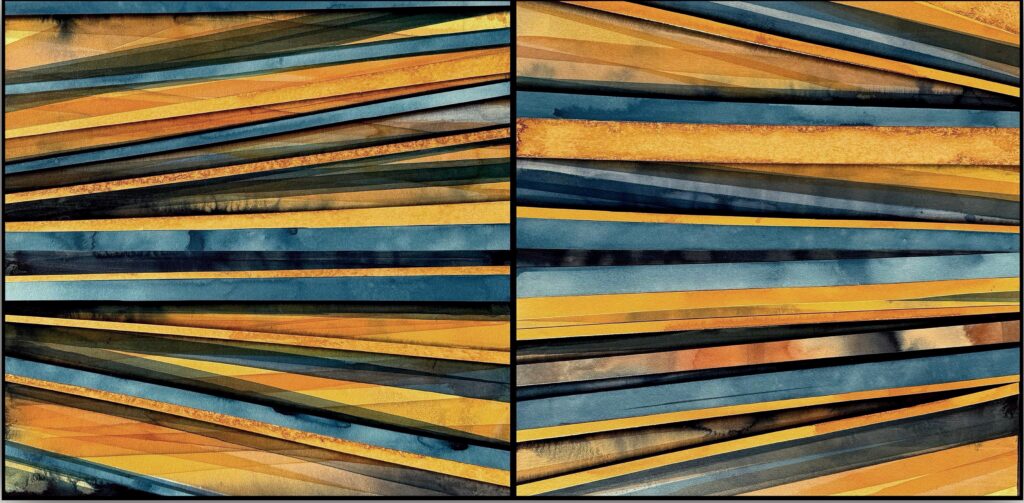
In his new works for Elements: Allison Stewart and Michael Kessler, Kessler carries that lifelong exploration into an expansive new use of color. Hickorygrove and Limbstalkers retain recognizable elements of the forest, while the new Velocity series moves further into abstraction through vivid polychrome palettes, repeated strip fields and diagonal compositions charged with energy.
Speaking from the road—between camping, fishing and delivering paintings—Kessler discussed his enduring relationship with the woods, the evolution of his collage process and the freedom he has found in what he calls “breaking the color open.”
The tree connection started when I was 14. I had a sketchbook and began sketching trees. Trees were the first things I started drawing.
I love being among ponderosas. Where there are ponderosas, there are often aspens too, so you get that combination. I live in the Southwest, where it’s mostly desert until you reach 8,000 or 9,000 feet. Then you’re in the ponderosas. Wherever I am, I try to get up to that elevation.
I live in the Southwest, where it’s mostly desert until you reach 8,000 or 9,000 feet. Then you’re in the ponderosas. Wherever I am, I try to get up to that elevation. I camp, fish and hang out. That’s where the lakes and rivers are. I often hang a hammock and watch the night sky or the daytime sky through the canopy. I have peaceful, meditative times there.
When you’re in the forest, you’re very aware of the ecosystem and the birds. You’re hidden away and have your own space. I think something primal happens in our psychology when we’re in a forest. We connect psychologically in a very deep way.
Then there are the visuals. It’s beautiful to watch the breeze blow through the trees and the leaves shudder. You have all these parallel vertical lines—the trunks—and can see through them. There’s overlap and vertical banding.
That became something I keyed into. It became my icon and the motif I kept returning to. I found that I could build paintings and create series by altering a few aspects. All my life, I’ve worked in that vein, basically abstracting the forest. That’s what I do and what I’ve always done.
Those are recent paintings that continue the forest imagery. They retain depicted aspects, whereas Velocity and some of the strip fields are more nonobjective and less about depicting the forest. They’re more abstract.
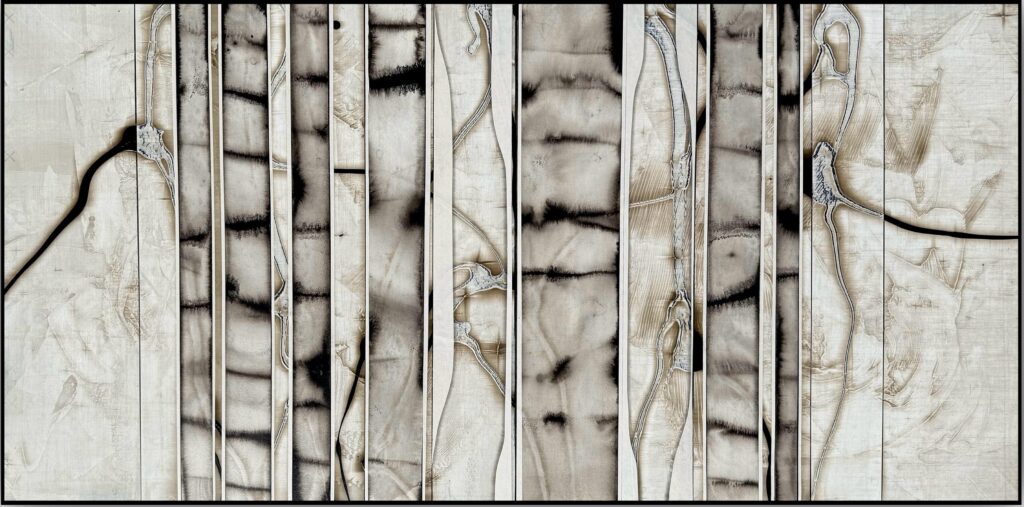
I like to contrast disparate elements. The straight vertical lines created by the paper strips play nicely against the painted, organic, curvilinear lines. It’s another form of contrast: straight vertical geometry against organic, branch-like, meandering and fluid forms. They complement each other.
I’ve been doing a lot of collage. The way I work with collage is to take paper strips—usually two inches wide—and paint them. I treat them like tree elements: trunks and trees. For years, I’ve been integrating that into paintings, building up layers and making compositions where you’re looking through tree trunks to a vista behind them.
I kept making more and more discoveries on those paper strips. I thought, “What if I really start going wild with the color and have fun painting the strips, without worrying too much about depicting a forest?” I could make simple compositions of parallel lines or strips—what I call “strip fields”—and play with color, becoming a pure colorist for a while.
That’s what has happened with the Velocity series and related pieces. I’m concentrating on color and how one color interacts with another. People say they still see aspects of the forest, but the works are more abstract and nonobjective.
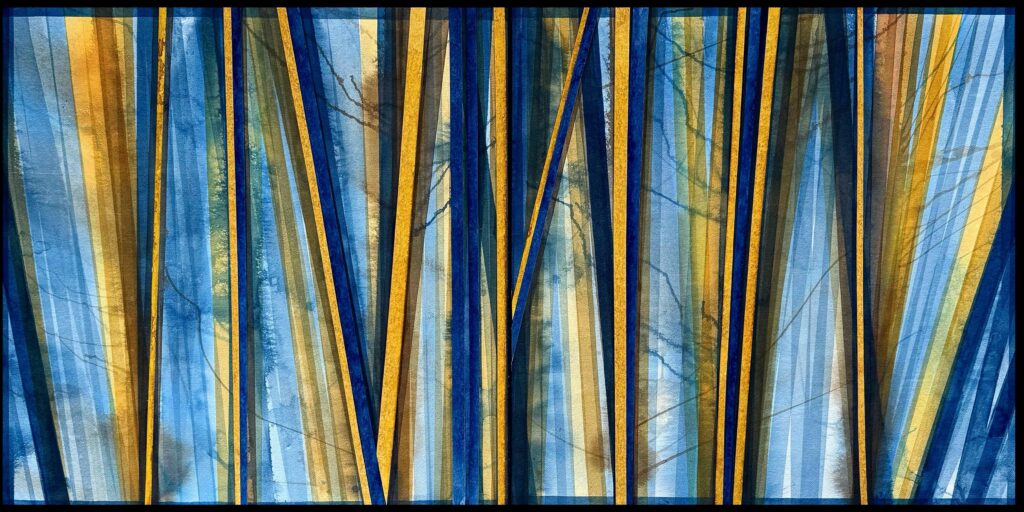
I buy a lot of my art supplies from building-supply stores. I realized that drywall tape is paper. It’s two inches wide and comes on a big roll. The tape is very absorbent and made of white paper.
I started using ink because ink has properties paint doesn’t. The pigments are ground extremely finely and suspended in a binder that doesn’t reconstitute once it’s dry. It’s also lightfast and archival. I realized I could do many things with colored ink on paper strips. Once they’re dry, I can glue or mount them to a canvas or panel. The process is pretty simple, but the possible combinations are endless.
Once I put down a field of strips, I’ll often skim over it with acrylic paint. That’s an old technique I’ve used for decades. I use translucent and transparent skim paint over the surface. It brings out the texture, and then I use many of my other techniques over that. It’s a hybrid process.
There’s a certain movement and speed in the paintings. I started working with diagonal compositional elements, and there was a sense of velocity—movement, energy and force. The word came into my mind and seemed applicable to what was happening visually.
There are many kinds of movement and undulation. With color and overlapping forms, you get push and pull. There’s lateral movement, like water, wind or trees moving in a breeze. All those references come to mind.
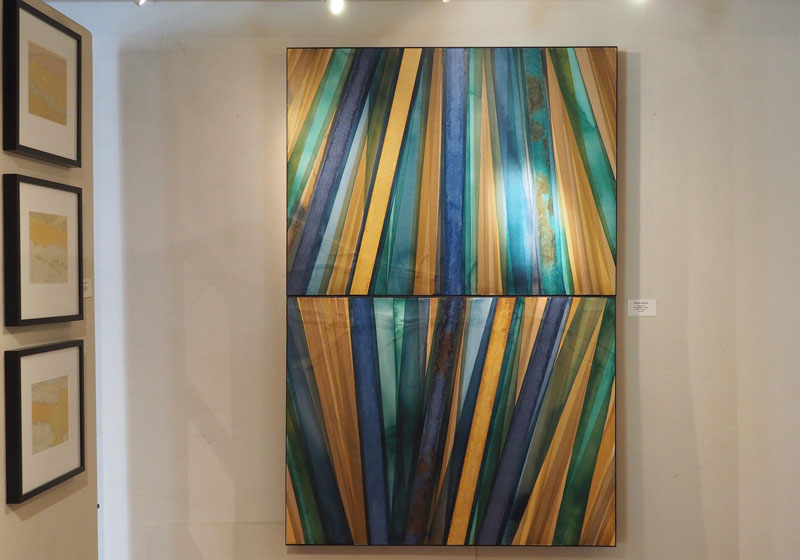
Many of my paintings have used a restricted palette, often with a brighter or richer color juxtaposed with a neutral—tan and blue, red and black, or a lot of white and black.
These new works are polychrome. I’m breaking the color open and working with color in all its variety. I’ve pulled out all the stops. I’m being very intuitive and free with the color and simply exploring. Color is vast. Once you get into its dynamics, there’s no end to the discoveries you can make.
Indigo has become very important to me. It’s the baseline color I’m working with. I can get the most beautiful indigo with ink, then make it warmer or cooler, neutralize it, and play other colors against it. Moving from indigo to green is exciting. You can place a super-intense green next to indigo and make the color pop. It’s hard to put into words, which is why color is so much fun. Color is like music.
Ever since I encountered Philip Glass and Steve Reich—the minimalist composers—when I was in college, I’ve loved minimalist music. It’s constructed through the repetition of like elements. They take similar elements, repeat them, and create transitions, transformations and movements.
In a way, this work is a visual form of minimalist music.
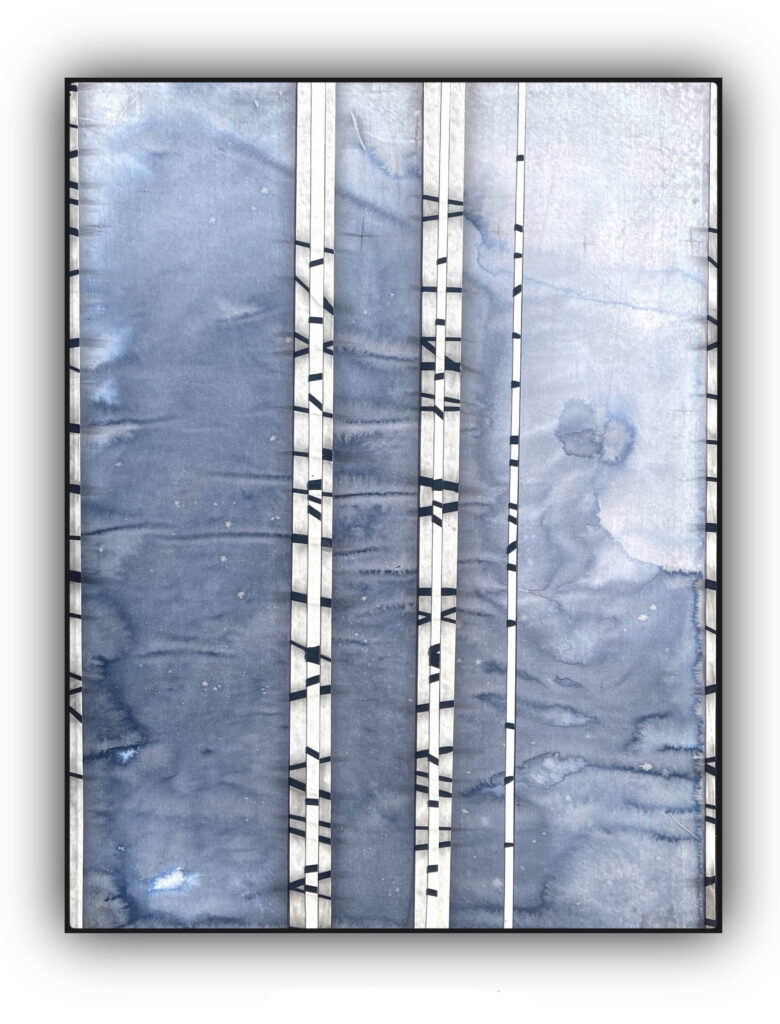
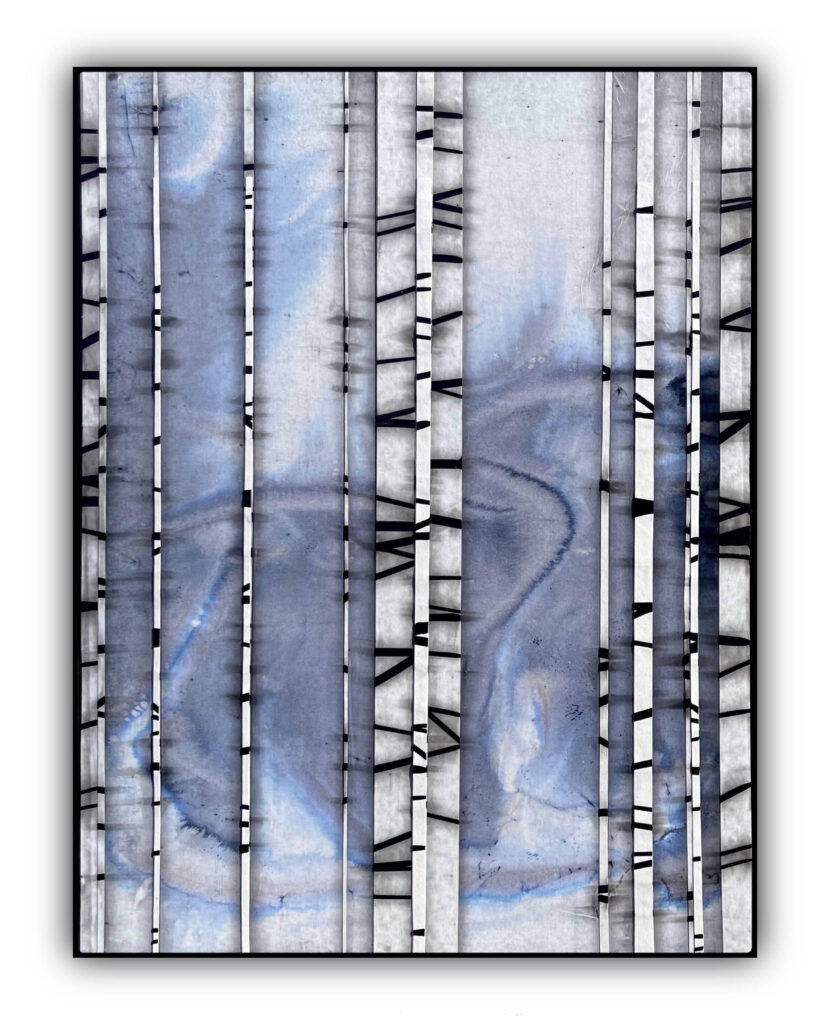
The layering—under and over—creates depth and informs you about the process: what came first, second and last. There’s an element of time, so people can become involved in the paintings on many different levels.
When I’m in the woods, observing the forest is similar to looking at a painting. I see things that happened years ago. There may be a tree with a fire scar or one that was hit by lightning. I can see events that happened in the past. I can read the forest in terms of its history.
I want my paintings to have that same quality: you can read the history of the painting.
I’ve only been working this way for about six months. It’s very new. My whole life, I’ve wanted to do this. For one reason or another, I never allowed myself to break open into color like this.
Now I’m 72 years old, and it’, “if not now, then when?”
I don’t want to repeat myself until my dying days. I like making discoveries and coming up with new things.
Explore Michael Kessler’s available works and visit Ann Korologos Gallery to experience Elements: Allison Stewart and Michael Kessler.

